Reviews for Online Sellers: Rules, Responses and a Checklist
You cannot control what customers write, but you can control how you deal with it. This guide explains what marketplaces and the law allow when asking for reviews, how to respond to criticism calmly, and what a fixed review routine looks like.
Contents
Customer reviews are part of everyday life for every online seller: on Amazon, on eBay, in your own shop and on your Google Business Profile. You cannot force good reviews. What you can control is how you handle them: how you ask for reviews, how you respond to criticism and what you must avoid along the way.
The rules come from two directions. Marketplaces have their own policies, and since 28 May 2022 additional legal requirements on the authenticity of reviews apply across the EU. This guide brings both together.
Product review or seller feedback?
First, it helps to be clear about what a review is actually about:
- Product reviews are about the item itself.
- Seller feedback is about your service: shipping, packaging, communication.
Amazon keeps these strictly apart. According to the Amazon.de Community Guidelines, comments about sellers, ordering issues, returns, shipping, packaging and product condition do not belong in product reviews. You can report such content to Amazon using the "Report" link next to the review.
What marketplaces prohibit
Amazon
The Amazon.de Community Guidelines are clear:
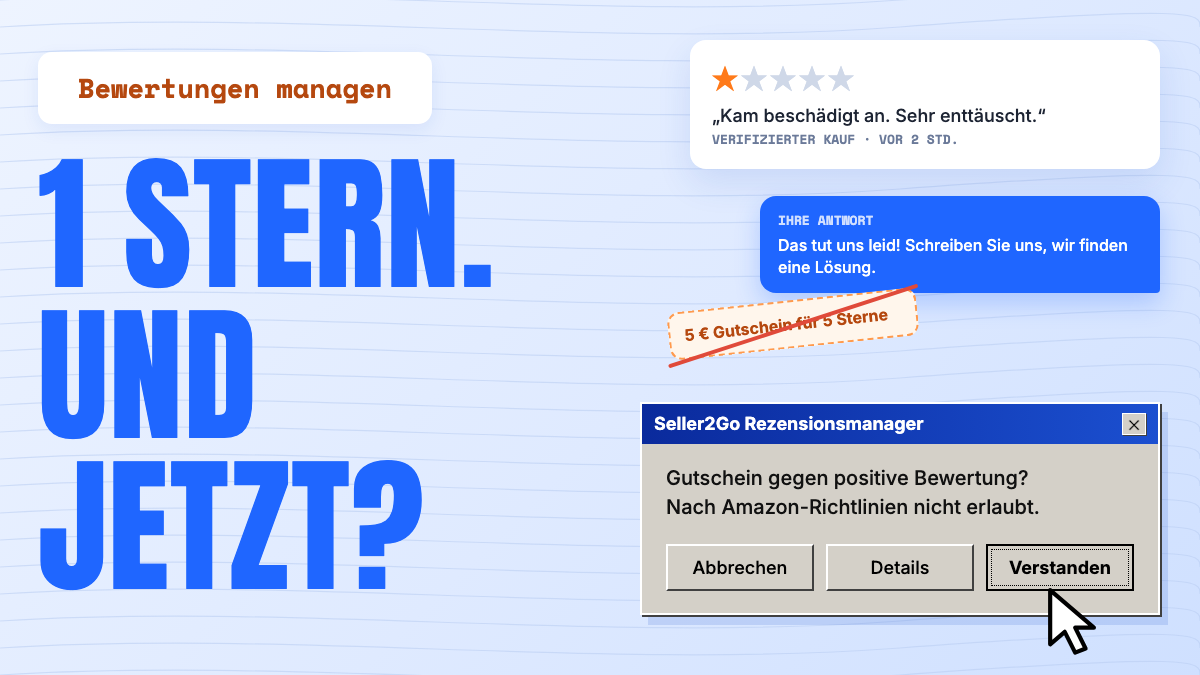
- No compensation: Reviews that are created, edited or removed in exchange for compensation are not allowed. According to Amazon, compensation includes cash, discounts, free products, gift cards and refunds.
- No reviews of your own products: You may not create content about your own products. The same applies to products of friends, relatives, employers, business associates and competitors.
- Vine exception: Reviews of free products received through the Amazon Vine programme are allowed and are labelled as such.
Amazon gives its own examples of prohibited behaviour, including a gift card in the package that can only be redeemed after posting a positive review, and an email after a negative review offering a refund if the review is changed or removed.
According to Amazon, possible consequences include removing content and related products, suspending or terminating the account, and withholding payments.
eBay
eBay's feedback manipulation policy prohibits any manipulation of feedback and Detailed Seller Ratings. This includes:
- Discounts, free items or other benefits in exchange for positive feedback
- Buying, selling or promoting feedback
- Exchanging feedback through multiple accounts or with other members
- Referring to eBay feedback in item titles or descriptions
eBay's retaliatory feedback policy also applies. One of its examples is a seller who receives feedback they consider unfair and then rates the buyer positively but adds a very negative comment. That is a violation too.
What eBay does allow: sellers can reply to comments or photos in a feedback entry and ask the buyer to revise the feedback. The buyer then has 10 days to accept or decline the request. If the buyer does not respond, the feedback stays unchanged.
What the law requires
EU Directive 2019/2161 (the "Omnibus Directive") tightened the rules on consumer reviews. Member states had to apply them from 28 May 2022. In Germany, the rules are set out in the Act against Unfair Competition (UWG).
Disclosure duty (Section 5b(3) UWG). If you make consumer reviews available, for example in your own shop, information on whether and how you ensure that reviews come from customers who actually used or bought the product counts as material information. Withholding it can be misleading (Section 5a(1) UWG).
Verbraucherzentrale NRW, a German consumer advice centre, makes the point clearly: if you do not check reviews, you must disclose that too. In its view, a note only on a subpage or in the small print is not enough. In a 2025 spot check of 462 websites, the consumer advice centres sent warning letters to 122 providers that had not informed, or not sufficiently informed, customers about how they verify reviews.
Prohibited practices (Annex to Section 3(3) UWG). These practices towards consumers are always unlawful:
- No. 23b: claiming that reviews come from real buyers or users without taking reasonable and proportionate steps to check this
- No. 23c: submitting fake reviews or recommendations or commissioning others to do so, and misrepresenting reviews or recommendations on social media to promote sales
"Always unlawful" means the circumstances of the individual case do not matter.
Responding to negative reviews
A public reply speaks to two audiences: the customer and everyone who reads the review later. These principles work well:
- Stay factual: No accusations, no irony, no counter-attacks.
- Be specific: Address the actual problem instead of hiding behind stock phrases.
- Keep customer data private: Never post order numbers, addresses or other details publicly.
- Offer a solution with no strings attached: A refund or replacement must never depend on the customer changing or deleting the review.
- Find the cause internally: If complaints about the same issue keep coming, the problem usually lies in the product, the listing or the shipping.
Reply templates (examples only, please adapt)
The following texts are samples only. Adapt them to the individual case and to the reply options of each platform.
Item arrived damaged:
"Hello, we are sorry to hear that. A damaged item should never reach you. Please contact us via the messaging system and we will find a solution together."
Product did not meet expectations:
"Thank you for your honest feedback. We have reviewed the product description and added a note on [point]. If you would like to return the item, we are happy to help."
Criticism you cannot trace:
"Thank you for your review. Unfortunately we cannot match the case you describe. Please contact us so that we can look into it."
Asking for reviews: what is allowed
The policies and the law point to a simple line:
- Ask neutrally: Ask for an honest review, not a positive one.
- No incentives: No discounts, vouchers, free items or refunds in return for a review.
- No reviews from your own circle: No reviews by employees, family or business partners.
- No bought reviews: neither directly nor through a service provider.
- Use platform tools: Check in each marketplace's seller area which features and rules apply to review requests.
A note on visibility: be sceptical of promises that more reviews automatically lead to better rankings. Only what the platform itself publishes on this is reliable.
Checklist for your review process
- List all review sources (marketplaces, shop, Google)
- Schedule fixed times to go through new reviews
- Report reviews that break the rules via the platform
- Reply to critical reviews factually and without customer data
- Never tie a solution to a change of the review
- Analyse recurring criticism internally and fix the causes
- In your own shop, explain clearly and visibly whether and how reviews are checked
- Word review requests neutrally and send them without incentives
Seller2Go Review Manager
For reviews on your Google Business Profile, there is the Seller2Go Rezensionsmanager (Review Manager). It is already available and helps you write replies faster:
- Connect your Google account: reviews from all locations of your Google Business Profile in one place
- AI reply drafts: in your brand's tone, for single or multiple reviews
- Filters: for example for unanswered, low-rated or recent reviews
- Full control: Nothing is published automatically. Every draft waits for your approval.
- Archive: published replies with timestamps
Reviews on Amazon, eBay and other marketplaces are still handled in each marketplace's seller area.
Note: This article is for general information only and is not legal advice. As of October 2026.