How to Calculate Landed Costs: What an Imported Product Really Costs
The supplier's price is only the starting point. This guide shows how to calculate the real cost of an imported product, which costs go into the customs value and the import VAT base, and how to plan pallets and containers.
Contents
When you buy goods from Asia or anywhere else outside the EU, the first number you compare is usually the supplier's unit price. For pricing decisions, that is not enough. Before the product reaches your warehouse, you pay for freight, insurance, customs duty, import VAT, handling and currency effects. Together these are your landed costs.
Underestimate them and you price on a margin that does not exist. This guide covers the building blocks, how duty and import VAT are calculated in Germany, and how to plan pallets and containers.
The building blocks of landed costs
- Purchase price: the amount on the supplier invoice, often in a foreign currency
- Freight: pre-carriage in the country of origin, main carriage (sea, air, rail, road), on-carriage to your warehouse
- Insurance: cargo insurance, if it is your responsibility
- Customs duty: depends on the product's tariff code and country of origin
- Import VAT (Einfuhrumsatzsteuer): charged on import in addition to duty
- Handling: transshipment, unloading, goods receipt, labelling
- Currency: the exchange rate at payment and at customs clearance
Which of these you pay and which the supplier covers depends on the agreed delivery term.
Incoterms: who pays for what?
The Incoterms® 2020 rules published by the International Chamber of Commerce (ICC) are eleven standard delivery terms. They define who bears which costs and risks on which leg, but not ownership transfer or payment terms. For importers, these are the most relevant:
- EXW (Ex Works): The supplier only makes the goods available for collection. Transport, loading and even export clearance are your job.
- FOB (Free On Board): The supplier delivers once the goods are on board at the named port of shipment and handles export clearance. You pay the main carriage. Sea and inland waterway only.
- CIF (Cost, Insurance and Freight): The supplier pays freight and minimum insurance to the port of destination. Risk, however, passes to you at the port of shipment.
- DAP (Delivered at Place): The supplier bears costs and risk to the named destination, but not import clearance.
- DDP (Delivered Duty Paid): The supplier also handles import clearance and bears all costs to the destination.
For container shipments, the IHK (German Chamber of Commerce) generally recommends FCA, CPT or CIP rather than FOB, CFR or CIF, because containers are usually handed to the carrier before they are loaded on the vessel. Always state the rule, version and place in the contract, for example "FOB Shanghai, Incoterms® 2020".
Customs duty and import VAT: what they are based on
Customs value. The starting point is the transaction value, meaning the price actually paid (Article 70 of the Union Customs Code). Added to it are, among other things, transport and insurance costs up to the place where the goods enter the EU (Article 71(1)(e)). Transport costs after entry into the EU are not included (Article 72). If you buy FOB, you therefore add the sea freight to the EU port to the value of the goods.
Duty rate. It follows from the product's tariff code. German Customs provides the Electronic Customs Tariff (EZT-online), which contains the EU TARIC data. It also shows whether anti-dumping duties, licences or prohibitions apply. If you are unsure about the classification, you can apply for Binding Tariff Information (BTI, German: vZTA).
Import VAT. In Germany, the tax base is the customs value plus duty plus transport costs to the first destination in the EU (Section 11 of the German VAT Act, UStG). The standard rate is 19 percent, with 7 percent for certain goods (Section 12 UStG).
Currency. Conversion follows the customs rules (Section 11(5) UStG, Article 53 UCC). What counts is the rate published by the authorities, not the rate on your bank transfer.
You also need an EORI number for the customs declaration.
Worked example
All figures are made up for illustration only. The duty rate is fictitious.
You buy 1,000 units at USD 8.00 FOB Shanghai, sea freight to Hamburg, warehouse in Lower Saxony. Assumed exchange rate: USD 1 = EUR 0.90. Fictitious duty rate: 4 percent.
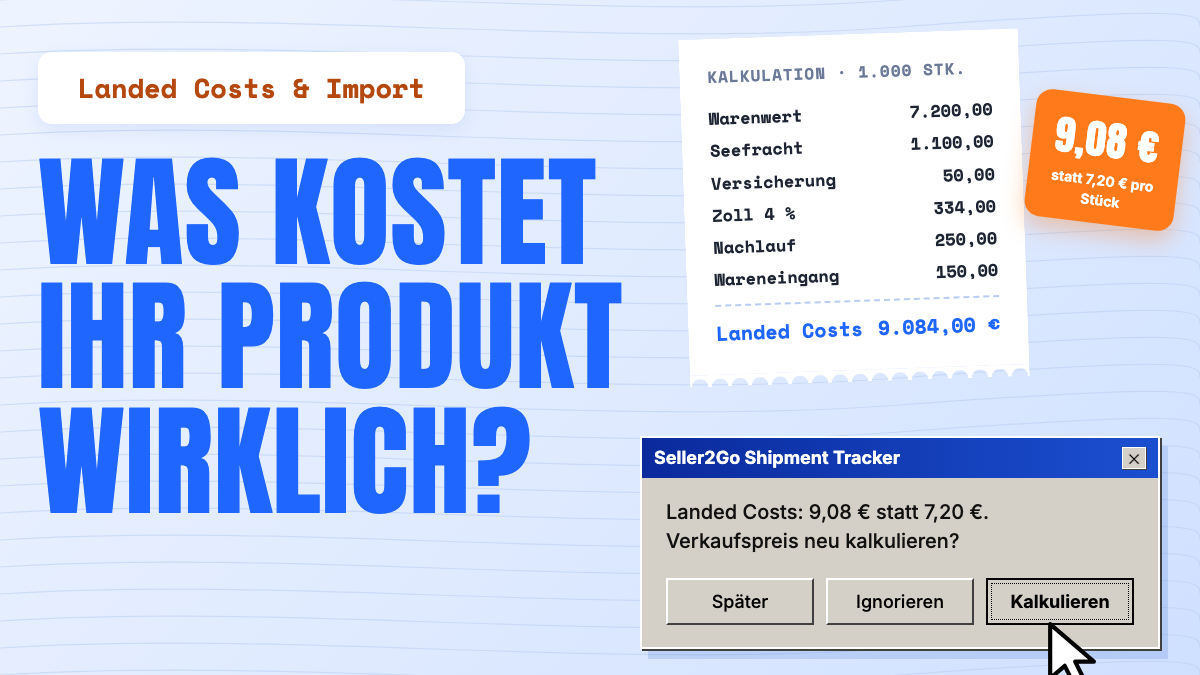
- Value of goods (USD 8,000 × 0.90): EUR 7,200.00
- + Sea freight to Hamburg: EUR 1,100.00
- + Cargo insurance: EUR 50.00
- = Customs value: EUR 8,350.00
- Duty (4% of 8,350.00): EUR 334.00
- Customs value + duty + truck Hamburg–warehouse (250.00): EUR 8,934.00
- Import VAT (19% of 8,934.00): EUR 1,697.46
Your landed costs add up as follows: goods 7,200.00 + freight 1,100.00 + insurance 50.00 + duty 334.00 + on-carriage 250.00 + goods receipt and labelling 150.00 = EUR 9,084.00, or EUR 9.08 per unit instead of EUR 7.20. That is just over 26 percent above the bare purchase price.
Import VAT is not included. If you are entitled to deduct input tax, you can deduct it (Section 15(1) no. 2 UStG). It is then not a cost, but it does tie up cash: in this example, EUR 10,781.46 is committed until the VAT is recovered.
Currency effect: If the rate moves to USD 1 = EUR 0.95, the goods are worth EUR 7,600.00, duty rises to EUR 350.00 and landed costs reach EUR 9.50 per unit. A currency move of just over 5 percent adds 42 cents to every unit.
Planning pallets and containers
Freight per unit depends on how well you use the space. An example with made-up carton sizes:
- Pallet: The EPAL Euro pallet measures 1,200 × 800 mm, is 144 mm high and carries up to 1,500 kg.
- Carton: 400 × 300 × 250 mm, 20 units, 12 kg.
- Layer: Placed one way, 4 × 2 = 8 cartons fit per layer. Turned the other way, only 3 × 2 = 6.
- Height: With an assumed maximum load height of 1.60 m including the pallet, 5 layers fit: 40 cartons or 800 units per pallet.
- Weight: 40 × 12 kg plus about 25 kg for the pallet is around 505 kg, well below the load capacity.
So 1,000 units (50 cartons) need two pallets, the second carrying only 10 cartons. It often pays to adjust order quantities to full layers or full pallets.
The same logic applies to containers: check floor space, height and permitted weight. Whichever runs out first limits the quantity, not volume alone. Get exact internal dimensions and payloads from your forwarder or shipping line.
Common mistakes
- Comparing offers on different Incoterms without adding the missing costs
- Leaving freight and insurance out of the customs value: they belong in it up to the EU border
- Wrong tariff code: a different duty rate changes the whole calculation
- Using your bank's exchange rate: customs uses the officially published rate
- Ignoring import VAT in cash planning: even if you recover it, the money is tied up first
- Planning by volume only: weight, stacking height and pallet size get overlooked
- No planned-vs-actual check: costs are not reconciled once the invoices arrive
Checklist for your import calculation
- Record the Incoterms rule, version and place in the contract
- Check the tariff code and duty rate in EZT-online; apply for BTI if unsure
- Include freight and insurance to the EU border in the customs value
- Include on-carriage to the first destination in the import VAT base
- Budget for handling and goods receipt
- Run exchange-rate scenarios
- Plan cartons, layers, pallets and weight before ordering
- Include import VAT in your cash planning
- Compare planned and actual costs once all invoices are in
Seller2Go Shipment Tracker
For these steps we are building the Seller2Go Shipment Tracker, a module inside Seller2Go. According to the product page, it covers:
- Capacity planning: pallets, cartons and loads for a full load or a target quantity, including mixed pallets
- Cost calculation: duty by country of origin and clearance fees down to unit, carton and pallet level, allocation by product cost, weight or units, multiple currencies
- Planned-vs-actual reconciliation once invoices arrive
- Shipment record with approval workflow, attachments and ETA alerts
- Product and packaging data imported from JTL-Wawi via the REST API
The product page describes order planning and shipment records as available now, and live carrier tracking as "coming soon".
Note: This article is for general information only and is not legal or tax advice. Duty rates, VAT rates and procedures can change. Have your calculation checked by your forwarder, customs adviser or tax adviser. As of October 2026.